
What Parents and Students Should Consider Before Choosing a Law Program
Key Highlights
- Understand the important factors parents and students should evaluate before selecting a law program.
- Explore how curriculum, faculty expertise, practical exposure, and career support influence legal education.
- Learn why skill development and industry exposure are essential for future legal professionals.
- Discover the factors that help students make informed decisions while exploring a Good Law College.
- Know how the right law program builds strong foundations for successful legal careers.
Table of Contents
- Introduction
- About Us
- What Factors Should Students Evaluate Before Choosing a Law Program?
- How Does Practical Exposure Improve Legal Education?
- Why Are Faculty Expertise and Curriculum Important in Law Studies?
- How Does Career Support Help Law Students Build Successful Futures?
- Conclusion
- FAQs
Introduction:
Choosing a law program is a significant decision that shapes a student’s professional journey and future opportunities. At AnangPuria, the Good Law College in Faridabad where with the legal sector expanding across corporate law, litigation, compliance, intellectual property rights, and public policy, students need an education that goes beyond understanding legal theories. A well-structured law program should develop analytical thinking, communication abilities, research skills, and practical understanding of legal processes.
About Us:
AnangPuria focuses on providing an educational environment that encourages academic excellence, professional growth, and practical understanding of legal concepts. The institution aims to help students develop essential legal skills through structured learning approaches, expert guidance, and exposure to contemporary legal practices.
By encouraging critical thinking, research abilities, and professional development, the institution supports learners in building the foundation required for successful legal careers. The learning approach focuses on preparing students to understand legal systems while developing confidence to address real-world challenges.
What Factors Should Students Evaluate Before Choosing a Law Program?
Selecting a law program requires more than considering the course duration or degree structure. Students and parents should analyse whether the program provides the right combination of theoretical knowledge and practical skills.
|
Evaluation Factor |
Importance |
|
Curriculum Structure |
Ensures understanding of modern legal concepts |
|
Faculty Expertise |
Provides quality academic guidance |
|
Practical Training |
Develops real-world legal abilities |
|
Moot Courts & Activities |
Improves advocacy skills |
|
Career Support |
Helps students explore opportunities |
Important factors to consider include:
- A curriculum covering essential areas of law and emerging legal fields.
- Opportunities for discussions, case analysis, and legal research.
- Development of communication and argument-building skills.
- Exposure to legal professionals and industry practices.
- Support for internships and professional growth.
A carefully designed law program helps students develop the confidence and competence required for a successful legal career.
How Does Practical Exposure Improve Legal Education?
Law is a profession that requires strong application skills along with theoretical understanding. Practical exposure allows students to experience how legal principles work in real situations and prepares them for professional responsibilities.
Practical learning opportunities include:
- Moot Court Sessions: Help students develop courtroom presentation and argument skills.
- Legal Research Activities: Improve analytical thinking and interpretation abilities.
- Internships: Provide exposure to legal workplaces and professional practices.
- Case Studies: Help students understand real legal scenarios.
Through practical experiences, students learn how to analyse cases, present arguments, and approach legal challenges effectively. These activities create a bridge between classroom knowledge and professional expectations.
A strong legal education system focuses on developing professionals who can confidently apply their knowledge in different legal environments.
Why Are Faculty Expertise and Curriculum Important in Law Studies?
Experienced faculty members play a major role in shaping a student’s understanding of legal concepts. Knowledgeable educators help learners explore different perspectives, analyse complex cases, and develop strong legal reasoning.
An effective law curriculum should include:
- Fundamental legal principles and concepts.
- Contemporary legal developments.
- Research-based learning opportunities.
- Practical applications of legal theories.
- Awareness of changing legal frameworks.
Students benefit when educators combine academic knowledge with practical insights from the legal field. This approach allows learners to understand not only what laws state but also how they are applied in professional situations.
A future-focused curriculum prepares students to adapt to changing legal requirements and emerging career opportunities.
How Does Career Support Help Law Students Build Successful Futures?
Career guidance is an important factor when choosing a law program. The legal profession requires continuous learning, professional networking, and practical experience to achieve long-term success.
Career support helps students through:
- Internship guidance and professional exposure.
- Skill development workshops.
- Resume preparation and interview assistance.
- Networking opportunities with legal professionals.
- Guidance about different legal career paths.
Law graduates can explore careers in areas such as corporate law, litigation, judiciary services, legal consulting, compliance, and public administration. Proper career support helps students identify their strengths and choose suitable professional directions.
Parents should consider institutions that focus on overall career development rather than only academic achievements.
Conclusion:
Choosing the right law program requires careful consideration of academic quality, practical learning opportunities, faculty expertise, and career support. A strong legal education should prepare students with the knowledge, skills, and confidence needed to succeed in a competitive professional environment.
FAQs:
Q1. What factors should families consider before selecting a law program?
Ans: AnangPuria focuses on academic quality, practical learning, faculty guidance, and career development opportunities.
Q2. How does practical learning help law students?
Ans: Moot courts, research activities, and case studies improve legal understanding and professional skills.
Q3. Why are communication skills important for future lawyers?
Ans: AnangPuria helps students strengthen argument-building, presentation, and analytical abilities required in legal careers.
Q4. How does a modern law curriculum benefit students?
Ans: Updated legal concepts and practical approaches help learners understand changing professional requirements.
Q5. What role does career guidance play in legal education?
Ans: AnangPuria supports students with skill development and professional preparation for different legal fields.
Q6. Why choose a law program focused on overall development?
Ans: AnangPuria combines legal knowledge with practical experiences to create confident future professionals.

What Makes a Pharmacy Program Ideal for Aspiring Healthcare Experts
Key Highlights
- Understand the essential factors that define a career-focused pharmacy program.
- Explore how practical training, research exposure, and industry learning shape future healthcare professionals.
- Learn why choosing the right institution matters for students pursuing pharmacy careers.
- Discover important aspects to evaluate while selecting among the Top 10 B Pharma College.
- Know how modern pharmacy education prepares students for opportunities in healthcare and pharmaceutical industries.
Table of Contents
- Introduction
- About Us
- What Features Make a Pharmacy Program Ideal for Students?
- How Does Practical Training Enhance Pharmacy Education?
- Why Are Research Opportunities Important in Pharmacy Programs?
- How Does Industry Exposure Prepare Future Healthcare Experts?
- Conclusion
- FAQs
Introduction:
The healthcare sector is continuously evolving with advancements in medicine, technology, and pharmaceutical research. At AnangPuria, the Top 10 B Pharma College in Faridabad where the demand for skilled healthcare professionals increases, pharmacy education has become more focused on developing professionals who can contribute effectively to patient care, drug development, and healthcare innovation. A well-designed pharmacy program should not only provide theoretical knowledge but also build practical expertise, research abilities, and professional skills.
About Us:
AnangPuria focuses on providing pharmacy education that supports academic growth, practical learning, and professional development. The institution aims to create an environment where students can strengthen their understanding of pharmaceutical sciences while gaining exposure to modern healthcare practices.
What Features Make a Pharmacy Program Ideal for Students?
An ideal pharmacy program goes beyond teaching pharmaceutical concepts. It prepares students to understand medicines, healthcare systems, and the responsibilities associated with improving patient outcomes.
|
Essential Feature |
Importance in Pharmacy Education |
|
Updated Curriculum |
Keeps students aligned with healthcare advancements |
|
Laboratory Training |
Develops practical pharmaceutical skills |
|
Experienced Faculty |
Provides academic and industry guidance |
|
Research Opportunities |
Encourages innovation and scientific thinking |
|
Industry Exposure |
Builds professional understanding |
A strong pharmacy program should include:
- Comprehensive understanding of pharmaceutical sciences.
- Practical sessions to develop technical abilities.
- Exposure to current healthcare challenges.
- Opportunities for innovation and research.
- Development of communication and professional skills.
These elements help students become confident healthcare professionals capable of adapting to the changing pharmaceutical landscape.
How Does Practical Training Enhance Pharmacy Education?
Pharmacy is a field where practical knowledge plays a crucial role in understanding medicines, formulations, and healthcare applications. Laboratory-based learning allows students to experience pharmaceutical processes and develop essential technical expertise.
Practical training helps students:
- Understand drug formulation and testing procedures.
- Learn laboratory techniques and safety practices.
- Apply scientific concepts through experiments.
- Develop accuracy and attention to detail.
Hands-on experiences improve students’ confidence by allowing them to connect theoretical concepts with real pharmaceutical applications. Regular practical exposure prepares learners to handle professional responsibilities effectively after graduation.
Modern pharmacy education focuses on creating professionals who can contribute not only as medicine experts but also as researchers, healthcare advisors, and industry specialists.
Why Are Research Opportunities Important in Pharmacy Programs?
Research plays a significant role in pharmaceutical development and healthcare innovation. Students who gain research exposure develop the ability to analyse problems, explore solutions, and contribute to advancements in medicine.
Research-oriented learning helps students:
- Understand drug discovery and development processes.
- Explore emerging areas in pharmaceutical sciences.
- Improve analytical and scientific thinking.
- Develop innovative approaches toward healthcare challenges.
A quality pharmacy program encourages students to participate in research projects, academic activities, and scientific discussions. This exposure creates a foundation for students interested in careers related to pharmaceutical research, clinical studies, and advanced healthcare solutions.
How Does Industry Exposure Prepare Future Healthcare Experts?
The pharmaceutical industry requires professionals who understand both scientific concepts and workplace expectations. Industry exposure helps students gain insights into professional practices and career opportunities.
Important industry-oriented learning opportunities include:
- Internships with pharmaceutical organisations.
- Expert sessions by healthcare professionals.
- Workshops focused on current technologies.
- Exposure to pharmaceutical production and quality processes.
These experiences help students understand real-world applications of pharmacy knowledge. They also improve communication skills, teamwork abilities, and professional confidence.
A career-focused pharmacy program ensures that graduates are prepared to meet industry standards and contribute effectively to healthcare development.
Conclusion:
An ideal pharmacy program creates a balance between theoretical understanding, practical skills, research exposure, and professional development. As healthcare continues to advance, pharmacy graduates need strong scientific knowledge along with the ability to adapt to new technologies and industry requirements.
FAQs:
Q1. What should students look for in a pharmacy program?
Ans: AnangPuria provides a learning environment focused on scientific knowledge, practical training, and healthcare skills.
Q2. How does practical training benefit pharmacy students?
Ans: Laboratory exposure and application-based learning help students understand pharmaceutical concepts effectively.
Q3. Why is research exposure important in pharmacy education?
Ans: AnangPuria encourages scientific thinking and innovation to help students explore advancements in healthcare.
Q4. How does industry exposure support pharmacy careers?
Ans: Professional interactions and practical experiences prepare students for pharmaceutical industry requirements.
Q5. What skills help students become successful healthcare professionals?
Ans: AnangPuria focuses on technical knowledge, analytical abilities, communication, and professional confidence.
Q6. Why is choosing the right pharmacy program important?
Ans: AnangPuria helps students build a strong foundation for diverse career opportunities in healthcare.
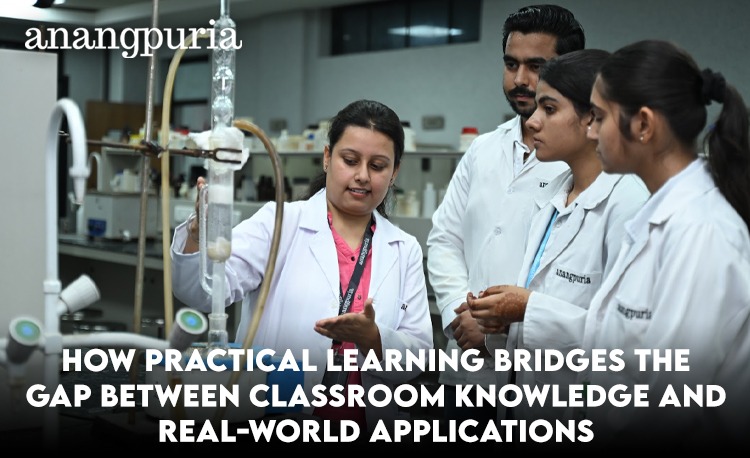
How Practical Learning Bridges the Gap Between Classroom Knowledge and Real-World Applications
Key Highlights
- Understand why practical learning is essential for modern engineering education.
- Explore how hands-on experiences improve technical skills and industry readiness.
- Learn how real-world projects enhance problem-solving and innovation abilities.
- Discover important factors students should consider while choosing among the Top Engineering Colleges.
- Know how experiential learning prepares students for successful professional careers.
Table of Contents
- Introduction
- About Us
- Why Is Practical Learning Important in Engineering Education?
- How Do Real-World Projects Help Students Apply Classroom Knowledge?
- Why Does Industry Exposure Matter for Engineering Students?
- How Does Skill Development Prepare Students for Future Careers?
- Conclusion
- FAQs
Introduction:
Engineering education has always been built on strong theoretical foundations, but today’s rapidly changing industries demand much more than textbook knowledge. At AnangPuria, the Top Engineering College in Haryana focuses on students on the ability to apply concepts, solve practical challenges, and develop innovative solutions that address real-world problems. This is where practical learning becomes a crucial part of modern technical education, helping learners connect academic concepts with professional applications.
About Us:
AnangPuria focuses on creating an educational environment where students can develop technical knowledge along with practical skills required for professional success. The institution encourages learning beyond traditional classrooms through interactive teaching methods, project-based activities, and exposure to real-world engineering applications.
Why Is Practical Learning Important in Engineering Education?
Traditional classroom teaching provides students with essential theoretical concepts, but practical learning helps them understand how these concepts work in real situations. Engineering is a field where application-based knowledge plays a major role in creating effective solutions.
Practical learning helps students:
|
Learning Method |
Student Benefit |
|
Laboratory Experiments |
Improves technical understanding |
|
Industry Projects |
Provides real-world exposure |
|
Workshops |
Develops practical expertise |
|
Internships |
Builds workplace readiness |
|
Innovation Activities |
Encourages creative thinking |
The advantages of practical education include:
- Better understanding of engineering principles through direct application.
- Improved ability to analyse and solve technical problems.
- Development of teamwork and communication skills.
- Increased confidence while handling professional responsibilities.
Engineering students who regularly engage in practical activities are better prepared to face challenges beyond academics.
How Do Real-World Projects Help Students Apply Classroom Knowledge?
Real-world projects allow students to move beyond theoretical concepts and experience the process of designing, developing, and implementing solutions. These projects encourage learners to think critically and understand how engineering ideas create practical impact.
Through project-based learning, students can:
- Apply classroom theories to solve actual problems.
- Understand the complete process of engineering development.
- Improve research and analytical abilities.
- Learn project management and collaboration skills.
For example, designing prototypes, developing software solutions, conducting experiments, or working on engineering models helps students understand industry expectations. These experiences create a deeper connection between academic learning and professional applications.
Why Does Industry Exposure Matter for Engineering Students?
Industries constantly evolve with advancements in technology, automation, and innovation. Therefore, engineering students need exposure to current industry practices to understand professional requirements.
Industry exposure helps learners:
- Gain insights from experienced professionals.
- Understand workplace processes and expectations.
- Learn about emerging technologies and trends.
- Develop professional networks.
Activities such as internships, expert sessions, technical workshops, and industry collaborations provide students with valuable experiences. These opportunities help learners understand how engineering knowledge is used to create solutions in different sectors.
A strong engineering institution focuses on developing professionals who can confidently transition from academic environments to corporate workplaces.
How Does Skill Development Prepare Students for Future Careers?
Technical knowledge alone is not enough for engineering graduates to succeed in competitive industries. Employers increasingly look for candidates who possess a combination of technical expertise and professional skills.
Important skills developed through practical learning include:
- Problem-Solving Skills: Helps students analyse challenges and create effective solutions.
- Technical Skills: Improves understanding of tools, technologies, and engineering processes.
- Communication Skills: Enables better teamwork and professional interaction.
- Leadership Skills: Builds confidence to manage projects and responsibilities.
- Adaptability: Helps students adjust to changing industry requirements.
Practical learning environments encourage students to experiment, learn from mistakes, and continuously improve their abilities. This creates future-ready engineers who can contribute effectively to organisations.
Conclusion:
Practical learning plays a significant role in transforming engineering education by connecting classroom concepts with real-world applications. It enables students to understand technical principles better while developing creativity, confidence, and professional skills.
When choosing an engineering program, students should consider institutions that provide opportunities for hands-on learning, industry interaction, and skill development. A balanced approach combining theoretical knowledge with practical experiences prepares learners to become capable professionals who can successfully contribute to the future of technology and innovation.
FAQs:
Q1. Why is hands-on learning important for engineering students?
Ans: AnangPuria emphasises practical experiences that help learners apply theoretical concepts to real engineering situations.
Q2. How do projects improve technical understanding?
Ans: Project-based learning allows students to develop innovation, teamwork, and problem-solving skills.
Q3. What makes practical exposure valuable for future engineers?
Ans: Real-world experiences help students understand industry expectations and build professional confidence.
Q4. How does engineering education benefit from industry interaction?
Ans: AnangPuria encourages exposure to professional practices, helping students connect academic knowledge with workplace requirements.
Q5. Which skills can students develop through experiential learning?
Ans: Learners improve technical expertise, communication abilities, analytical thinking, and adaptability.
Q6. Why is application-based education important today?
Ans: AnangPuria prepares students to handle modern engineering challenges through practical and skill-focused learning.

What to Look for in a Future-Focused MBA Program Before Taking Admission
Key Highlights:
- Understand the essential features of a future-ready MBA program before making a career decision.
- Explore the importance of industry exposure, skill development, and practical learning.
- Learn how modern management education prepares students for evolving business challenges.
- Discover factors that help students choose among the Best MBA Colleges.
- Know why curriculum innovation, faculty expertise, and career support matter for long-term success.
Table of Contents
- Introduction
- About Us
- What Makes an MBA Program Future-Focused?
- How Does Industry Integration Enhance MBA Learning?
- Why Are Skill-Based Learning and Specialisations Important?
- How Do Placements and Career Support Influence MBA Decisions?
- Conclusion
- FAQs
Introduction:
Choosing an MBA program is one of the most important decisions for students aspiring to build successful careers in management, entrepreneurship, consulting, finance, marketing, and other business domains. At AnangPuria, the Best MBA Colleges in Gurgaon where with industries rapidly evolving due to technology, automation, and globalisation, students today need more than traditional business knowledge. A future-focused MBA program should prepare learners with practical skills, leadership abilities, and adaptability to succeed in competitive professional environments.
About Us:
AnangPuria focuses on providing management education that encourages academic excellence, professional development, and industry-oriented learning. The institution aims to create an environment where students can enhance their managerial abilities through classroom learning, practical experiences, and exposure to contemporary business practices.
What Makes an MBA Program Future-Focused?
A future-focused MBA program goes beyond textbooks and traditional lectures. It combines business fundamentals with emerging industry requirements to create well-rounded professionals.
|
Important Factor |
Why It Matters |
|
Updated Curriculum |
Helps students understand current business trends |
|
Industry Exposure |
Provides practical understanding of corporate challenges |
|
Technology Integration |
Builds digital and analytical capabilities |
|
Leadership Development |
Improves decision-making and management skills |
|
Career Guidance |
Supports professional growth and opportunities |
A strong MBA program should include:
- Contemporary subjects related to business analytics, digital transformation, entrepreneurship, and innovation.
- Case-based learning methods that encourage critical thinking.
- Opportunities to participate in projects, workshops, and industry interactions.
- Development of communication, teamwork, and leadership abilities.
Students should evaluate whether an institution focuses on preparing graduates for future business environments rather than only providing theoretical knowledge.
How Does Industry Integration Enhance MBA Learning?
Modern businesses require professionals who can immediately apply their knowledge in practical situations. Therefore, industry exposure plays a significant role in determining the quality of an MBA program.
Industry-oriented learning helps students:
- Understand real corporate challenges through case studies and projects.
- Gain insights from industry experts and business leaders.
- Develop workplace skills through internships and practical assignments.
- Learn how management concepts are applied across different sectors.
Interactions with professionals allow students to understand market expectations and emerging career opportunities. A future-ready MBA program creates a bridge between academic concepts and professional applications, helping learners become more confident before entering the corporate world.
Why Are Skill-Based Learning and Specialisations Important?
Business roles are becoming increasingly specialised, making skill development a crucial part of management education. Students should choose programs that offer opportunities to explore their interests while developing industry-relevant abilities.
Key areas students should consider include:
- Marketing Management: Builds expertise in branding, consumer behaviour, and digital marketing strategies.
- Finance Management: Develops understanding of financial planning, investments, and business decisions.
- Human Resource Management: Focuses on talent management and organisational development.
- Business Analytics: Helps students use data for strategic decision-making.
- Entrepreneurship: Encourages innovation and startup thinking.
Along with specialisations, students should look for opportunities to improve:
- Communication skills
- Leadership capabilities
- Analytical thinking
- Problem-solving approach
- Professional confidence
These skills create a strong foundation for long-term career growth.
How Do Placements and Career Support Influence MBA Decisions?
Career opportunities are among the most important factors students consider while selecting an MBA program. A reliable career support system helps learners transition smoothly from academics to professional roles.
Before choosing an institution, students should analyse:
|
Career Support Feature |
Benefit |
|
Placement Assistance |
Helps connect students with employment opportunities |
|
Resume Building |
Improves professional presentation |
|
Interview Preparation |
Enhances confidence during recruitment |
|
Industry Networking |
Creates valuable professional connections |
|
Career Counselling |
Helps students make informed decisions |
A future-focused MBA program should provide continuous career development support rather than limiting assistance to final placements. Mentorship, skill workshops, and corporate interactions play a major role in shaping successful management professionals.
Conclusion:
Selecting the right MBA program requires careful evaluation of multiple factors beyond rankings and reputation. Students should focus on institutions that provide a combination of academic knowledge, practical exposure, industry learning, and professional skill development.
FAQs:
Q1. What factors define a future-focused MBA program?
Ans: AnangPuria focuses on industry-oriented learning, practical exposure, and skill development to prepare students for evolving business opportunities.
Q2. How can students develop leadership abilities during management studies?
Ans: The program encourages strategic thinking, communication skills, and decision-making abilities required for successful management careers.
Q3. Why is practical learning important in an MBA course?
Ans: AnangPuria integrates real-world applications with classroom concepts to help students understand modern business challenges.
Q4. How does an updated curriculum benefit MBA aspirants?
Ans: A contemporary curriculum helps learners stay connected with changing industry trends and emerging business practices.
Q5. What role does career support play in management education?
Ans: Career guidance, skill training, and professional development initiatives help students prepare for corporate opportunities.
Q6. How does this MBA program prepare students for future industries?
Ans: AnangPuria develops adaptable professionals with analytical, managerial, and problem-solving capabilities.
How Hands-On Engineering Experience Builds Future Technology Leaders
Key Highlights
- Understand why hands-on engineering education is essential in today’s technology-driven world.
- Learn how practical learning prepares students for real-world engineering challenges.
- Discover the importance of innovation labs, live projects, internships, and industry collaborations.
- Explore the technical and professional skills required to become future technology leaders.
- Find out what students should consider while choosing the best engineering college in Faridabad.
- Learn how experiential learning enhances employability, innovation, and leadership capabilities.
Table of Contents
- Introduction
- About Us
- Why Is Hands-On Engineering Education Important?
- How Does Practical Learning Develop Future Technology Leaders?
- Which Skills Do Engineering Students Need for Emerging Industries?
- How Do Industry Exposure and Innovation Shape Career Success?
- Traditional Engineering Education vs Hands-On Learning
- Conclusion
- FAQs
Introduction
Engineering has always been at the forefront of innovation, driving advancements in infrastructure, manufacturing, automation, artificial intelligence, renewable energy, and digital transformation. At Anangpuria, the top engineering college in Haryana, as industries rapidly adopt emerging technologies, employers increasingly seek engineers who can solve real-world problems, work collaboratively, and apply technical knowledge beyond the classroom. This changing landscape has made hands-on engineering education a crucial element in preparing students for successful careers.
About Us — An Engineering College on Sohna Road Faridabad
At Anangpuria, a well-established engineering college on Sohna road Faridabad, engineering education is designed to combine academic excellence with hands-on learning and innovation. The institution offers an AICTE-approved curriculum and provides students with modern laboratories, experienced faculty, industry-oriented curriculum, research opportunities, internships, technical workshops, innovation projects, and collaborative learning experiences. Through a strong emphasis on practical application, leadership development, and emerging technologies, students are prepared to become confident professionals capable of addressing complex engineering challenges in a rapidly evolving global landscape.
Key Components of Hands-On Engineering Education
| Learning Area | Career Benefit |
|---|---|
| Engineering Laboratories | Practical technical expertise |
| Design and Development Projects | Problem-solving and innovation |
| CAD & Simulation Tools | Industry-ready technical skills |
| Robotics & Automation | Exposure to modern technologies |
| Industrial Training | Real-world workplace experience |
| Research Activities | Innovation and analytical thinking |
| Industry Certifications | Enhanced employability |
| Team-Based Projects | Leadership and collaboration skills |
Why Is Hands-On Engineering Education Important?
Engineering is an application-based discipline where practical implementation is just as important as theoretical understanding. Hands-on learning enables students to experiment, analyze, and innovate while developing confidence in solving engineering challenges — a quality that separates a best engineering college in Faridabad from theory-only institutions.
Key Benefits of Practical Engineering Education
- Strengthens conceptual understanding
- Encourages innovation and creativity
- Builds technical proficiency
- Develops analytical thinking
- Improves problem-solving abilities
- Enhances teamwork and communication
- Increases industry readiness
- Promotes lifelong learning
Students who regularly participate in practical activities are often better prepared to meet the evolving demands of technology-driven industries.
How Does Practical Learning Develop Future Technology Leaders?
Leadership in engineering goes beyond technical expertise. It requires strategic thinking, collaboration, adaptability, and the ability to manage projects effectively. Practical learning environments help students cultivate these qualities through real-world experiences.
Experiential Learning Activities
- Live engineering projects
- Prototype development
- Robotics competitions
- Innovation and startup challenges
- Technical workshops
- Capstone projects
- Research collaborations
- Hackathons and coding events
These experiences encourage students to think creatively, work under deadlines, and develop solutions that address practical engineering problems.
Which Skills Do B.Tech CSE and IT Students Need for Emerging Industries?
The future of engineering demands professionals who possess both technical expertise and strong interpersonal abilities. Industry 4.0 technologies continue to reshape engineering careers across multiple sectors — especially for students of a B.Tech CSE college in Faridabad or a B.Tech IT college in Faridabad, where computing skills directly drive employability.
Technical Skills
- Programming Fundamentals
- Artificial Intelligence
- Machine Learning
- Internet of Things (IoT)
- Robotics
- CAD/CAM Software
- Embedded Systems
- Cloud Computing
- Data Analytics
- Cybersecurity Basics
Professional Skills
- Leadership
- Critical Thinking
- Project Management
- Communication
- Collaboration
- Time Management
- Creativity
- Decision-Making
- Adaptability
- Ethical Responsibility
Developing these competencies enables graduates to excel in engineering, research, manufacturing, consulting, and technology organizations.
How Do Industry Exposure and Innovation Shape Career Success?
Industry engagement bridges the gap between academic learning and professional expectations. Students gain valuable insights into workplace practices while building confidence and technical expertise. Unlike a typical engineering college in Gurgaon, institutions along the Ballabgarh-Sohna corridor offer strong industry connectivity with the Faridabad industrial belt.
Industry-Oriented Learning Opportunities
- Industrial internships
- Corporate mentorship programs
- Industry visits
- Guest lectures by experts
- Live consulting projects
- Research partnerships
- Entrepreneurship development programs
- Professional certification courses
- Placement readiness training
Such initiatives help students understand emerging technologies while expanding their professional networks.
Traditional Engineering Education vs Hands-On Learning
| Traditional Engineering | Hands-On Engineering Education |
|---|---|
| Theory-focused curriculum | Practice-oriented curriculum |
| Limited industry exposure | Strong industry collaborations |
| Classroom-based instruction | Live projects and laboratory work |
| Exam-centric assessments | Skill-based evaluations |
| Minimal innovation activities | Research and innovation ecosystem |
| Limited technology integration | Exposure to advanced engineering tools |
| Conventional learning methods | Experiential and collaborative learning |
Career Opportunities After Practical Engineering Education
Students equipped with practical engineering experience can pursue diverse career opportunities across industries.
Popular career options include:
- Design Engineer
- Software Engineer
- Mechanical Engineer
- Civil Engineer
- Electronics Engineer
- Automation Engineer
- Robotics Engineer
- Data Engineer
- AI Engineer
- Research Engineer
- Project Engineer
- Product Development Engineer
As industries continue embracing digital transformation, engineering graduates with practical experience enjoy broader career prospects and stronger employability.
Conclusion: The Top Engineering College in Haryana for Future Leaders
Hands-on engineering education plays a vital role in developing future technology leaders by integrating classroom learning with practical experience, innovation, and industry exposure. Students of the top engineering college in Haryana gain valuable technical knowledge, problem-solving abilities, leadership qualities, and professional skills that enable them to contribute effectively across engineering and technology sectors. Interested students can explore the admission process here.
FAQs
Q1. Why is Anangpuria Institute of Technology & Management better than conventional engineering colleges?
It prioritizes experiential learning and practical engineering exposure.
Q2. How does Anangpuria Institute of Technology & Management compare with traditional engineering institutes?
It emphasizes projects, innovation, and industry collaboration.
Q3. Does Anangpuria Institute of Technology & Management prepare students for future technologies?
Yes, students gain real-world technical and problem-solving skills.
Q4. Why choose Anangpuria Institute of Technology & Management over other engineering colleges?
Its industry-focused approach enhances career readiness.
Q5. How does Anangpuria Institute of Technology & Management develop technology leaders?
It encourages innovation, teamwork, and practical engineering experience.
Q6. Is Anangpuria Institute of Technology & Management a strong choice for engineering careers?
Yes, it equips students with industry-relevant technical competencies.